Let's Talk about Inspiration
The Shape of The Pain
By Chris Thorpe & Rachel Bagshaw

The Shape of the Pain is the first text I ever read that portrayed chronic illness in a way I could relate to. It’s a one woman show that follows a woman’s attempt to articulate her experiences of Complex Regional Pain Syndrome through a series of monologues and intricate lighting and sound effects. It also takes the audience through every stage of a relationship, from the first meeting to its eventual breakdown.
I was drawn to the relationship in the piece and the character’s resignation that there will always be three of them; her, him and the pain. This is something I struggle with in my own life and it inspired me to write about my own relationship and the ways in which it is affected by my illness. The piece is un-sentimental and presents the strength needed to navigate life with a pain condition. Below is one of my favourite excerpts:


CUTI
Verity De Cala
Last year I became involved with the development of a podcast centred around my illness (Chronic UTI or CUTI). The podcast explores the stories, the science and the culture surrounding the illness. It features interviews with myself and other sufferers of the illness as well as interviews from leading doctors in the field researching CUTI. It won the Independent Podcast Award 2024 for best educational / health podcast. Many people reached out to me after its release, both fellow sufferers thanking me for telling my story and people who had known nothing about the illness before listening. It felt good to talk about my experience on a public platform and inspired me to speak out more. The audio quality on here is crap but the real thing is fantastic.


Polly Atkin
Some Of Us Just Fall
Atkin’s thoughts around chronic illness and storytelling particularly resonated with me. She states that ‘illness makes storytellers of us all” (Atkin, 2023), as chronic illness sufferers are endlessly explaining and justifying themselves. She talks about how we come to minimise our own suffering, rehearsing the most palatable version of our experiences; ‘I bore myself with the version of my story I’ve learnt to repeat to others’ (Atkin, 2023). Since reading her book I’ve started noticing when I do this. I have my own spiel that I dust off and recount whenever I need to in social or professional situations. Atkin refers to this as the ‘lazy fiction’ we make of ourselves.
Going into this writing project, I knew that I wanted to create something that resisted this ‘lazy fiction’ and instead attempted to communicate the complex experience of existing with chronic illness.
A Spectacle of Herself
Laura Murphy
I saw Laura’s Murphy’s show, ‘A Spectacle of Herself’, as part of my research development. The show is an eclectic mix of clowning, monologues, lip-syncing and aerial hoop and it discusses themes such a neurodiversity, queerness, mental health and female rage. Overall, the piece felt like a snapshot into where Murphy exists in the world, and all the compounding factors that complicate this existence. Biography was folded into every aspect of her piece but it didn’t follow a specific narrative or storyline. It was a mishmash of different moments and experiences. This non-linear and layered approach to storytelling got me thinking about how to create my own multidisciplinary practice.


I attended an autobiographical writing course run by Laura Murphy in July. I learnt a lot of techniques to help generate autobiographical text quickly and I left with lots of prompts to help get me out of a writing rut. Some of my favourite prompts from the workshop are as follows:
1. Write 3-5 stories about key moments in your life – but in a strictly factual way (no adjectives)
This prompt inspired scene 6 of my show (see p.16). Although it developed into a spoken-word type performance, the text began as me trying to objectively recount various ways that people have offered me help and support. Listing these moments in a factual way allowed the emotion behind them to function as subtext and for the weight of these moments to speak for themselves.
Image: Photo of our workshop group :)
A Spectacle Of Herself, 2024
2. Write from the perspective of a body part
This exercise first made me think about my long suffering bladder. If it could speak, what would it say? How would it ask for help? I immediately thought of an overworked and drained character working in some sort of control room that was completely malfunctioning. It was potentially the first time I’ve ever felt sympathy for my bladder, rather than just feeling furious that it wasn’t doing its job correctly. This prompt ultimately inspired the whole pain and bacteria section of my show. I started picturing my bladder as a helpless entity caught in the crossfire of a particularly toxic relationship. (see p.17).
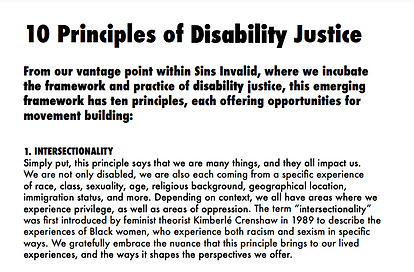
Disability Justice
Sins Invalid
I was also inspired by the 10 Principles of Disability Justice. The full document is linked here. These principles primarily inspired the ‘Party’ scene that didn’t make it into my IRP Presentation. (excerpt below) The full scene can be found in the Easter Egg section of the site.
Image: A Little Inquest into what it is we are Doing Here (2024)

A Little Inquest
Josie Dale-Jones
I saw ‘A Little Inquest’ at the Edinburgh Fringe Festival this year and found it incredibly inspiring. The story the show tells is as follows:
Dale Jone's wrote a show ‘for children and their parents and guardians’ called “The Family Sex Show”, a theatrical attempt to reimagine how children and their carers might talk openly and without shame about sex and relationships, boundaries and consent… Dale-Jones was dubbed a paedophile and encouraged to kill herself; someone threatened to bomb the theatres where the show was programmed'. (Gaul, 2024).
The show details how this experience affected her and discusses wider topics such as free speech and self-censorship. I really appreciated how ‘A Little Inquest’ demonstrated the subtle ways that an event or experience can bleed into every aspect of your life, including your relationships and sense of self. I’m really keen on this idea of ‘show, don’t tell’ in writing. I think Dale-Jone’s’ show is such a successful example of this. I tried to do something similar in my own show, particularly in one scene that I wrote early on and that didn’t make it into my IRP Presentation.
Here's that scene
Many other aspects of the show felt relevant to the development of my own. Dale-Jones would often flirt with metatheatrical constructs, for example, during the most naturalistic scene, candidly saying that she had only written the boyfriend character to make herself come across as more likeable. I loved the way that she would allude to the artificial/made up nature of what was happening as a tactic to win an argument. I also really enjoyed the unpredictability of the form. The form starts off fairly standard for a one-woman show, but then develops into a random dance number, various fits of clowning and then finally into a very naturalistic domestic scene. The controlled chaos of this form was really validating to see as my own show was shaping up in a similar way. It was a really inspiring example of non-linear storytelling.
